


The first sign that something had gone wrong was not an announcement or a decree, but an uneasy stillness. In early 1967, Nigerians across the country waited for reassurance that the upheavals of the previous year would not return. Instead, what filtered through were fragments of information. Senior military leaders had travelled to Ghana. They had met to discuss the survival of the country. They had returned without a shared understanding of what had been agreed.
Stability did not follow. Uncertainty did.
EXPLORE NOW: Biographies & Cultural Icons of Nigeria
The coups of 1966 and the ethnic violence that followed had already damaged public confidence and fractured the armed forces. Large numbers of civilians were displaced across regional lines, abandoning homes, work, and security. Authority was contested. Nigeria remained one country in name, but its unity depended on an agreement whose meaning was already under strain.
A Meeting at Aburi
That agreement emerged from Aburi, a town in Ghana, where Nigeria’s military leadership gathered in January 1967. General Yakubu Gowon, Head of the Federal Military Government, met with Colonel Chukwuemeka Odumegwu Ojukwu, Military Governor of the Eastern Region, alongside other senior officers.
The purpose of the meeting was clear. It was intended to halt Nigeria’s drift toward disintegration, restore confidence among the regions, and reduce the fear that had taken hold after months of instability. At its core, the discussions focused on power: how it should be shared, where authority should lie, and how future decisions would be made.
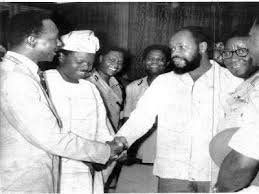
What the Accord Promised
The outcome of the talks, later known as the Aburi Accord, appeared to offer a way forward. Centralising decrees issued after the coups were to be repealed. Appointments to senior federal positions, including the police, diplomatic service, and civil service, would require the approval of the Supreme Military Council. Authority would no longer rest overwhelmingly at the centre.
To its supporters, the Accord signalled a shift toward a looser federation and a return to what was described as true federalism. It suggested that Nigeria’s regions could remain together without feeling dominated or exposed. For a brief moment, compromise appeared possible.
A Single Agreement, Two Readings
That moment did not last.
Almost immediately after the leaders returned from Ghana, differences in interpretation became apparent. Ojukwu understood the Accord as placing firm limits on federal authority and safeguarding regional control, including significant influence over military arrangements within the regions. In his reading, Aburi fundamentally rebalanced power away from the centre.
Gowon and the federal leadership did not accept this interpretation. From their perspective, Ojukwu was extending the Accord beyond its intent and advancing a level of regional autonomy that threatened national cohesion. What one side saw as protection, the other saw as fragmentation.
Decree No. 8 and the Collapse of Trust
Mutual suspicion deepened. Federal authorities believed the Eastern leadership was using Aburi to justify near complete autonomy. Ojukwu, meanwhile, grew convinced that the federal government was retreating from the agreement itself.
This mistrust came to a head with the promulgation of Decree No. 8. Intended by the federal government as a step toward implementing the Accord, it was interpreted very differently in the East. Ojukwu regarded it as a reversal that restored central authority where Aburi had promised restraint. To him, it confirmed that the spirit of the agreement had been abandoned.
Trust, already fragile, did not survive this moment.
A Country Without a Roadmap
Instead of clarifying authority, the Aburi Accord deepened uncertainty. Negotiations stalled. Each side questioned the intentions of the other. The space for compromise narrowed until it effectively disappeared.
For ordinary Nigerians, the effects were indirect but profound. While detailed civilian reactions are not recorded in available documentation, the political deadlock left fundamental questions unanswered. Who controlled security? Who could guarantee protection? Where did authority truly lie? The failure of Aburi meant that Nigeria had no shared framework to manage its crisis at a critical moment.
From Breakdown to War
Events moved quickly after that. With the Accord effectively broken, the last serious attempt to preserve Nigeria through negotiation collapsed. The Eastern Region declared itself the Republic of Biafra. Shortly afterwards, the Nigerian Civil War began in 1967.
The war did not emerge suddenly. It was the result of months of mistrust, failed agreements, and unresolved fears. Aburi had been a narrow opening, a chance to redefine power without violence. Its failure ensured that these questions would instead be settled by force.
What Aburi Came to Mean
In later memory, Aburi came to represent not what was achieved, but what was lost. It remains a symbol of a missed opportunity to restructure Nigeria peacefully and address regional concerns through agreement rather than conflict.
By the time fighting began, the promise made in Ghana was already beyond reach. What remained was fractured authority, hardened positions, and a war that would permanently reshape Nigerian society. Aburi did not end Nigeria’s crisis. It marked the moment when the possibility of ending it without war slipped away.
EXPLORE: Nigerian Civil War
Author’s Note
This article traces the rise and collapse of the Aburi Accord, a critical attempt to resolve Nigeria’s post coup crisis through negotiation and decentralisation. It highlights how differing interpretations, deep mistrust, and the failure to establish a shared understanding of power transformed a fragile peace into open conflict, leading directly to the Nigerian Civil War.
References
- John de St. Jorre, The Nigerian Civil War
- Tekena N. Tamuno, Separatist Agitations in Nigeria Since 1914
- Max Siollun, Oil, Politics and Violence: Nigeria’s Military Coup Culture

